Getting to the birth province of Mahatma Gandhi is sufficiently basic. Fiery Ahmedabad is the fundamental entryway if flying in and there is likewise the alternative to be driven across state and join an excursion around Gujarat with neighboring Rajasthan. Great streets inside Gujarat (some state they are the best in the nation!), implies that going around by escort driven vehicle is the most pragmatic (and pleasurable) approach to see the best of what this misjudged and little-visited some portion of India has to bring to the table. Furthermore, which better than the Indian part of The London Chauffeur RCS of London Ltd can escort better?
We've investigated Gujarat top to bottom and know it well. This is our rundown of must-see spots and most loved areas in Gujarat – all ideal spots for getting off-the-beaten-track in India.
LITTLE RANN OF KUTCH
Arranged in Gujarat's northwest corner, Little Rann of Kutch is a place where there is infertile salt swamp that is moon-like in its appearance and surface. However, throughout the cold weather months, this unforgiving scene gets home to a plenitude of transient waterbirds, including pelicans, flamingos and sandgrouse. Additionally, with 4,954 km² of this dry land being utilized as a safe-haven, it is just in the Little Rann that it is conceivable to see the jeopardized, and rather slippery Asiatic wild ass.
This piece of Kutch is additionally home to various semi-traveling ancestral networks, a significant number of whom earn enough to pay the bills by removing salt from the land. A visit to one of these towns is an intriguing and lowering experience and, as opposed to the district's aridness, a large number of the town's females, both youthful and old, embellish themselves with perfectly weaved and vivid customary dress.
Flamingos, Little Rann of Kutch
RAN-KI-VAV STEPWELL
Intricate and meticulously crafted, Ran-ki-Vav (Queen’s stepwell) is one of the state’s most stunning pieces of architecture. Situated in the northern Gujarati city of Patan on the banks of the Saraswati River, the detail that has gone into this magnificent structure is outstanding.
JUNAGADH
Positioned in the centre of Gujarat, Junagadh is an ancient, fortified city with a history dating back more than 2,000 years. One of 562 princely, or vassal, states during the British reign in the subcontinent, the city became part of neighbouring Pakistan for a short period after the partition of British India in 1947 but this didn’t last long and, today, the city is worth visiting for its temples, forts and other styles of architecture. Of all of the city’s architectural delights, without a doubt, the most outrageous is the jaw-dropping Mahabat Maqbara. Built as a mausoleum in 1892 for the late Nawab, Mahabat Khan II, it is a heady mix of Indo-Islamic, European, and Gothic styles. As the saying goes, “seeing, is believing” …
Mausoleum of the Wazir of Junagadh
BHUJ
Banni Village in Kutch near Bhuj
CHAMPANER-PAVAGADH ARCHAEOLOGICAL PARK
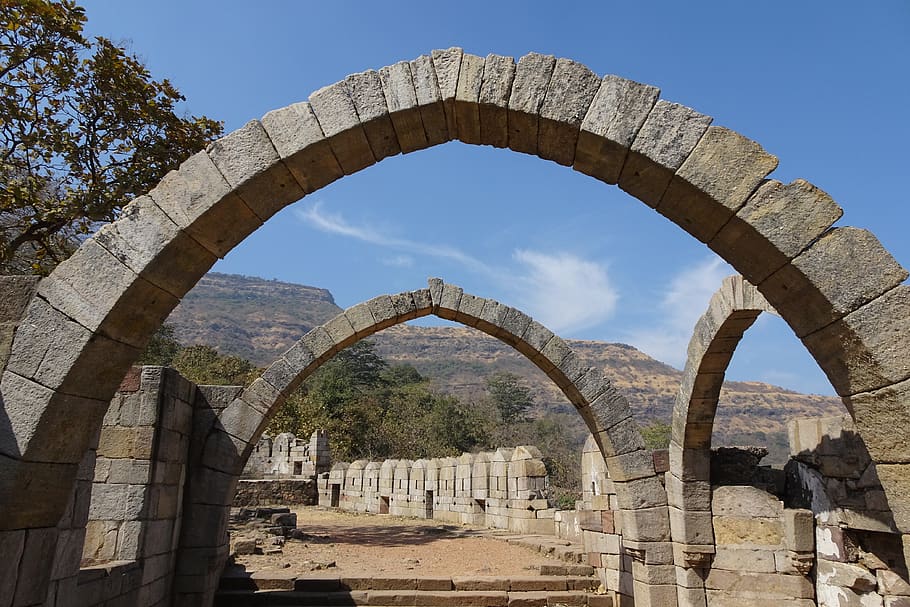
Comprising of the sacred volcanic hill of Pavagadh and the ruined historical city of Champaner, this marvellous archaeological park is one of three UNESCO World Heritage Sites situated in Gujarat. Once the capital of the state, Champaner was captured by the Mughal emperor, Humayun, in the early part of the 16th century and the centre of administration was then moved to Ahmedabad. Champaner is remarkably well preserved and inside the settlement are the remains of the citadel and the former palace as well as several mosques that are no longer in use. In contrast, Kalikamata Temple, which is situated on top of scenic Pavagadh Hill and dedicated to the Hindi goddess Kali, is still active and an important place of pilgrimage.
Champaner-Pavagadh is close to the city of Baroda (Vadodara), where there is the opportunity to overnight in the Jambughoda Palace, one of several atmospheric royal residences in Gujarat that have been part-converted into a heritage hotel and part-retained as the family’s ancestral home.
Champaner-Pavagadh Archaeological Park
SASAN GIR NATIONAL PARK
Chasing parties coordinated by the Indian first class for the British settlers implied that, before the finish of the nineteenth century, there were just around twelve Asiatic lions left in India. Fortunately, the region where this microscopic number of lions existed, Gir Forest in the southwest of Gujarat, was ultimately transformed into a completely ensured public park and these days there is in the locale of 500 Asiatic lions, with a sensibly high level of them being whelps.
Sasan Gir National Park is the main spot left on the planet where you can notice these great felines in nature. A bunch of fowls just as reptiles and other four-legged creatures likewise consider Sasan Gir their home and like so numerous other public parks in India, the forested territory is a fascination in its own right. Taking off on an early morning or late evening jeep safari when the climate is cooler and the light is inconspicuous is a paramount undertaking, whether or not lions are spotted or not.

Asiatic Lion of Sasan Gir
GONDAL
One of the highlights of visiting Gondal, a small but pleasant town in Gujarat’s southern peninsula, is the opportunity to experience a night or two in the charming Orchard Palace, a heritage property that was originally built by the Maharaja of Gondal to accommodate his personal guests. The maharaja’s collection of vintage cars, which includes a 1935 Mercedes seven-seat saloon and a 1947 Cadillac convertible, is housed in the grounds of the palace while, nearby, the former living quarters of the Naulakha Palace, which also belongs to the royal family, has been converted into a museum displaying an eclectic mix of personal effects and other memorabilia.

THE BEST TIME TO VISIT GUJARAT
Gujurat is best visited between September and March when the climate is pleasant and the rainfall is at a minimum. Visit in September and October and you are likely to witness musical and dancing celebrations throughout the state as part of the colourful Navratri festival, while the best months to see the Asiatic lions in the wildlife sanctuary of Sasan Gir are from November through to March.
ITINERARY IDEAS FOR A PRIVATE TOUR TO GUJARAT
We have as of late added four insightfully planned customized Gujarat schedules to our north India portfolio. Contrasting long, each visit incorporates an escort driven private vehicle, master guides and the most ideal convenience.
Classic Gujarat is the perfect introduction to this contrasting region of India with seven nights starting at just £1,595 per person. Travellers looking to spend longer may prefer our Grand Tour of Gujarat, a comprehensive fifteen-night journey.
Other suggestions include Tribes & Lions of Gujarat, an immersive experience highlighting the culture and wildlife of the region, and Gujarat & Ahilya Fort, a journey that also includes a stay at one of India’s most charming heritage hotels in the neighbouring state of Madhya Pradesh.
Our suggested itineraries are just that, and they can all be tailored to suit very specific requirements. Our experts on India are on hand to advise, so please get in touch.
Posted in indiaTagged culture, gujarat, india, north india, off-the-beaten-track, wildlifeBy Mark Bennetts


No comments:
Post a Comment